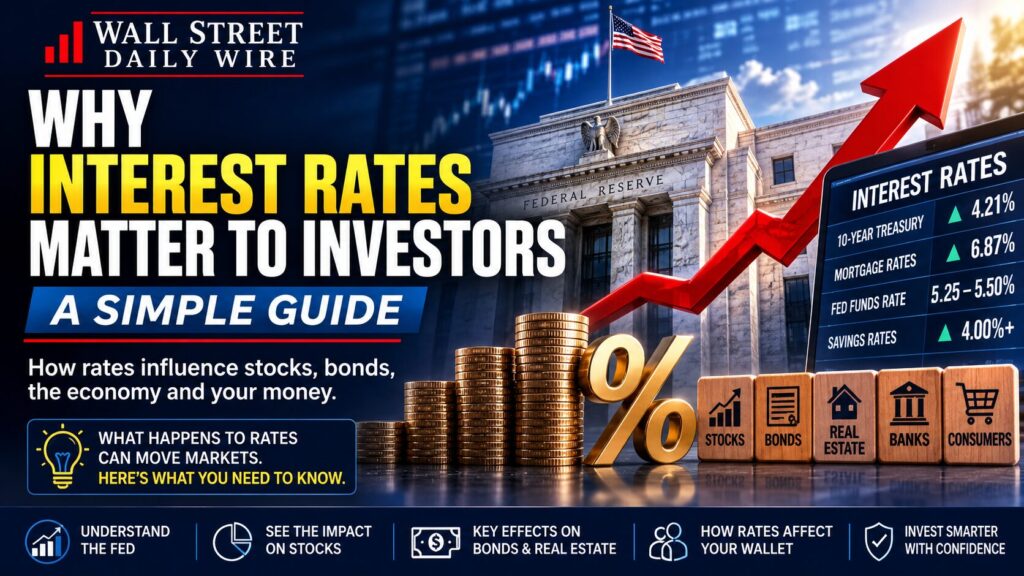
Interest rates may sound like one of the more technical parts of financial markets, but they affect nearly every corner of an investor’s portfolio.
They influence what consumers pay to borrow money, what businesses pay to finance expansion, how much income investors can earn from bonds and savings accounts, and even how investors determine what a stock may be worth.
When the Federal Reserve changes interest rates—or investors simply expect rates to change—the effects can ripple through stocks, bonds, real estate and the broader economy.
Understanding those relationships can make financial headlines considerably easier to interpret.
Start With the Federal Reserve
The Federal Reserve does not directly determine most of the interest rates consumers encounter.
Instead, one of its primary tools is the federal funds rate—the rate associated with overnight lending between banks.
Changes in monetary policy influence borrowing costs throughout the financial system.
When inflation is running too high, the Fed may maintain or raise rates to restrain economic activity.
When economic growth weakens significantly, policymakers may lower rates to encourage borrowing, investment and spending.
But financial markets rarely wait for the Fed to actually make a move.
Investors constantly evaluate economic data and attempt to anticipate what policymakers will do next.
That means stocks and bonds can move substantially based on changing expectations for future interest rates.
Why Higher Rates Can Pressure Stocks
One of the most important relationships involves stock valuations.
A share of stock represents a claim on a company’s future earnings and cash flows. Investors therefore care not only about how much money a company might generate, but what those future dollars are worth today.
Higher interest rates generally increase the return investors can obtain from lower-risk alternatives such as Treasury securities.
That can make stocks comparatively less attractive.
Higher rates also increase the rate investors use when valuing future corporate cash flows. The further into the future those expected profits lie, the greater the potential valuation effect.
Why Growth Stocks Can Be Especially Sensitive
This helps explain why rapidly growing technology companies can sometimes react strongly to changing interest-rate expectations.
Many growth companies are valued partly on profits investors expect them to generate years into the future.
When rates rise, the present value investors assign to those distant earnings can decline.
That does not mean rising rates automatically cause technology stocks to fall.
Corporate earnings, economic growth, artificial-intelligence spending, competitive advantages and numerous other factors can overwhelm the interest-rate effect.
Rates are one piece of the valuation equation—not the entire equation.
Interest Rates and Bonds
The relationship between rates and existing bond prices is generally more direct.
When market interest rates rise, existing bond prices generally fall.
When market interest rates fall, existing bond prices generally rise.
Suppose an investor owns a bond paying 3%.
If newly issued comparable bonds begin paying 5%, investors have little reason to pay full price for the older 3% bond.
Its market price would generally need to decline to make its effective yield more competitive.
The opposite can happen when rates decline.
A bond paying an attractive fixed rate may become more valuable when newly issued bonds offer lower yields.
This relationship is one of the fundamental concepts of fixed-income investing.
Why Bond Yields Matter to Stock Investors
Even investors who never purchase an individual bond should pay attention to the bond market.
Treasury yields effectively compete with stocks for investment capital.
If relatively low-risk government securities offer attractive yields, investors may demand greater potential returns before accepting the additional risks associated with equities.
One of the most closely watched benchmarks is the 10-year U.S. Treasury yield.
Its movements can influence mortgage rates, corporate financing costs and stock-market valuations.
A rapidly rising 10-year yield can therefore become an important market story even when the Federal Reserve has made no change to its policy rate.
What Higher Rates Mean for Businesses
Interest rates also affect companies directly.
Businesses routinely borrow money to:
- construct facilities,
- purchase equipment,
- acquire competitors,
- finance inventories,
- develop new products,
- repurchase shares, and
- refinance existing debt.
When borrowing becomes more expensive, some projects that previously made economic sense may no longer produce attractive returns.
Companies carrying substantial amounts of variable-rate debt can be particularly exposed because their interest expenses may increase as rates rise.
Companies with strong balance sheets, substantial cash reserves and manageable debt loads may be better positioned to withstand a prolonged period of higher borrowing costs.
Banks Are Different
Banks can sometimes benefit from higher rates.
A significant portion of traditional banking involves collecting deposits and lending that money at higher rates.
The difference between what a bank earns on its interest-producing assets and what it pays to obtain funding is central to banking profitability.
But higher rates aren’t automatically positive for banks.
Banks must also contend with deposit competition, credit losses, changing loan demand and the value of securities held on their balance sheets.
Extremely restrictive rates can eventually weaken borrowers and increase delinquencies.
The important question is therefore not simply:
Are rates high or low?
Investors should consider how the entire interest-rate environment affects a particular bank’s funding, lending and credit performance.
Real Estate and REITs
Real estate is another rate-sensitive area.
Higher borrowing costs can make mortgages more expensive for homeowners and financing more expensive for property developers.
Real estate investment trusts, or REITs, can also face higher financing costs.
At the same time, higher Treasury yields can create additional competition for income-oriented investments.
An investor comparing a REIT dividend with a Treasury yield may demand a greater potential return from the REIT because real estate carries additional risks.
Again, the relationship isn’t automatic. Property type, occupancy, rent growth, debt structure and management quality still matter.
Dividend Stocks Face Competition Too
Dividend-paying companies are sometimes viewed as bond substitutes, particularly by income investors.
When interest rates are extremely low, a reliable 4% dividend yield can look especially attractive.
If relatively safe fixed-income investments begin producing comparable yields, investors have more choices.
That doesn’t eliminate the appeal of dividend stocks.
Unlike a fixed bond payment, a healthy company’s dividend can potentially grow over time, and shareholders can participate in appreciation of the underlying business.
But higher rates change the alternatives available to investors.
Consumers Feel the Effects
Interest rates ultimately work their way into household finances.
Higher rates can increase borrowing costs associated with mortgages, auto loans, credit cards and other forms of consumer credit.
That can reduce disposable income and discourage large purchases.
For businesses dependent on discretionary consumer spending, this matters.
If households devote more income to debt payments—or simply become cautious because financing is expensive—retailers, restaurants, travel companies and other consumer-oriented businesses can feel the effects.
Lower rates can produce the opposite effect by making borrowing less expensive.
Why Markets Sometimes Rise When Rates Stay High
This is where interest-rate analysis becomes more complicated.
Markets don’t react to rates in isolation.
They react to rates relative to expectations and economic conditions.
Imagine investors expect the Federal Reserve to raise rates.
Instead, policymakers leave rates unchanged.
Rates haven’t fallen, but markets could still rally because the outcome was less restrictive than investors feared.
Likewise, a rate cut isn’t necessarily bullish.
If the Fed cuts rates because policymakers see evidence of a rapidly deteriorating economy, investors might focus more on recession risk than cheaper borrowing.
Context matters.
What Investors Should Watch
Instead of trying to predict every Fed decision, investors can monitor several indicators that help explain the interest-rate environment.
Federal Reserve decisions: Changes in the federal funds target range provide the clearest indication of current monetary policy.
Inflation: Persistent inflation can make policymakers reluctant to lower rates.
Employment: Weakening labor conditions can increase pressure for easier monetary policy.
Treasury yields: Bond markets continuously incorporate investors’ expectations about inflation, growth and future rates.
Corporate earnings: Ultimately, companies must produce profits capable of supporting their valuations regardless of the rate environment.