The Federal Reserve rate decision is in focus as policymakers begin their two-day meeting Tuesday, with the outcome suddenly looking considerably less routine than it did just a few weeks ago.
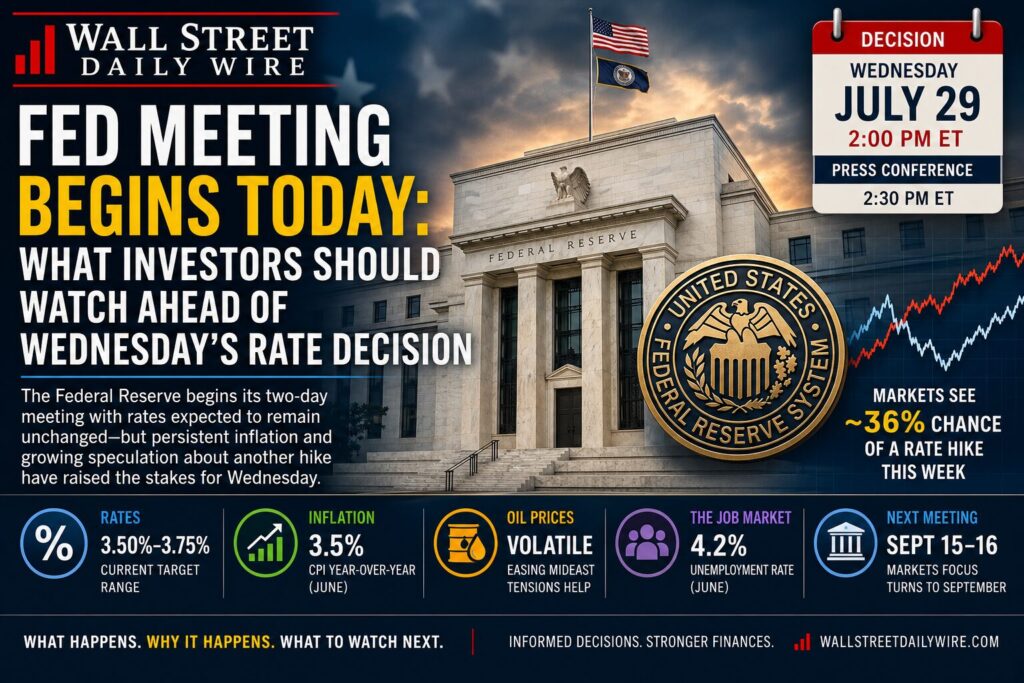
The Federal Open Market Committee meets July 28–29, with its interest-rate decision scheduled for 2:00 p.m. EDT Wednesday.
Most investors and economists still expect policymakers to leave interest rates unchanged.
But expectations have shifted.
Interest-rate futures on Tuesday were pricing roughly a one-in-three chance of a rate increase this week, while bond investors generally continued to expect the Fed to maintain its current target range of 3.50%–3.75%.
That means Wednesday’s Federal Reserve rate decision may not simply be about whether policymakers raise rates.
The bigger question is whether Chairman Kevin Warsh and his colleagues signal that another period of monetary tightening is approaching.
Federal Reserve Rate Decision: Inflation Isn’t Gone
The Federal Reserve has spent years trying to return inflation sustainably toward its 2% objective.
Recent data provided some encouraging news.
The Consumer Price Index declined 0.4% in June, the largest monthly decrease since April 2020. Falling energy prices were a major contributor, with the energy index declining 5.7% during the month.
But inflation remains elevated.
Consumer prices were still 3.5% higher than a year earlier.
That distinction matters.
One encouraging monthly inflation report does not necessarily establish a trend—and the Fed must determine whether recent improvement represents genuine progress or temporary relief.
Energy prices have complicated that calculation further.
Geopolitical tensions and volatile oil prices have periodically raised concerns about renewed inflation. More recently, easing tensions involving Iran have helped reduce some of the immediate pressure on fuel prices.
The result is an unusually uncertain backdrop for monetary policy.
Rates Are Already Restrictive
The Fed entered this week’s meeting with its target range at 3.50%–3.75%.
At its June meeting, policymakers left rates unchanged as Warsh presided over his first FOMC meeting as chairman.
The question now is whether existing monetary restraint is sufficient.
That debate has become more important because Warsh has emphasized maintaining the Fed’s commitment to its 2% inflation objective. Earlier this month, he made clear that investors shouldn’t expect the central bank to simply accept inflation persistently above that level.
Yet raising rates carries its own risks.
Higher borrowing costs affect mortgages, corporate financing, consumer credit and investment. Tightening too aggressively could eventually weaken economic activity or employment.
The Fed therefore faces a familiar balancing act—but one that has become increasingly difficult.
Why Wednesday Could Move Markets
Financial markets don’t react simply to whether the Federal Reserve raises or lowers rates.
They react to the difference between what happens and what investors expected to happen.
That creates three broad possibilities.
Scenario 1: Fed Holds and Sounds Patient
This would likely represent the least surprising outcome.
If rates remain unchanged and Warsh emphasizes recent inflation improvement and the need for additional data, investors could interpret the decision as relatively dovish.
That could provide some relief to interest-rate-sensitive assets.
Scenario 2: Fed Holds but Turns Hawkish
This may be the most interesting scenario.
The Fed could maintain rates Wednesday while signaling that another increase is increasingly possible if inflation fails to improve.
Markets would then immediately begin focusing on the September meeting.
A hawkish hold could push Treasury yields higher and create pressure on expensive growth stocks even though the Fed technically made no change to rates.
Scenario 3: Fed Raises Rates
This would produce the biggest surprise.
Futures markets on Tuesday were pricing approximately a 36% probability of an increase, meaning a hike cannot be dismissed—but it is not the consensus expectation.
An unexpected increase would likely cause investors to reassess expectations for the remainder of 2026.
The crucial question would immediately become:
Is this a one-time adjustment—or the beginning of another tightening cycle?
Five Things Investors Should Watch Wednesday
1. The Rate Decision
This is the obvious one.
Does the Fed maintain its 3.50%–3.75% target range or increase it?
But investors shouldn’t stop reading after seeing the headline.
2. The Language on Inflation
Watch how the FOMC characterizes recent inflation.
Any meaningful change in wording could provide clues about policymakers’ confidence—or lack of confidence—that inflation is moving sustainably toward 2%.
3. Kevin Warsh’s Message
Warsh has taken a different approach to forward guidance, making his press conferences particularly important.
Investors should listen for what conditions might persuade him that additional tightening is necessary.
4. Signs of Division Inside the Fed
Policymakers are not necessarily approaching inflation from the same perspective.
Some officials have expressed greater concern about persistent price pressures and the potential need for higher rates.
Any dissents—or Warsh’s discussion of internal disagreement—could provide useful information about the direction of policy.
5. September
Whatever happens Wednesday, markets will immediately begin pricing the Fed’s next move.
If policymakers hold rates but deliver a more hawkish message, the September 15–16 meeting could quickly become the next major market catalyst.
The Bond Market Is Already Nervous
The uncertainty isn’t confined to stocks.
Bond investors have become increasingly cautious about making large directional bets ahead of the Fed decision.
Persistent inflation and uncertainty surrounding the future path of interest rates have encouraged some professional investors to favor shorter-duration and higher-quality fixed-income assets while waiting for greater clarity.
That matters because Treasury yields influence borrowing costs throughout the economy.
Higher yields can affect everything from mortgages and auto loans to corporate financing and stock valuations.
And for equity investors, higher bond yields create another consideration:
Treasuries become more competitive with stocks when investors can earn attractive yields without assuming equity-market risk.
What It Could Mean for Stocks
Different portions of the market could react differently to Wednesday’s announcement.
Technology and growth stocks may be particularly sensitive to a hawkish surprise. Higher interest rates increase the discount rate applied to future corporate earnings, which can pressure valuations.
That issue is especially relevant now. Technology shares were already under pressure Tuesday amid concerns surrounding enormous AI infrastructure spending, with the Nasdaq falling as investors awaited major technology earnings and the Fed decision.
Small-cap companies can also be sensitive to rates because smaller businesses frequently depend more heavily on external financing.
Banks and financial stocks present a more complicated picture. Higher rates can benefit some lending spreads, but those benefits can be offset by higher funding costs, weaker loan demand or deteriorating credit quality.
Dividend stocks face increased competition when Treasury and other fixed-income yields rise.
The Fed decision therefore isn’t merely an economic story.
It affects the relative attractiveness of virtually every major asset class.
Another Major Test Arrives Thursday
Wednesday’s Fed decision won’t end the economic-data story.
It may make Thursday even more important.
The Bureau of Economic Analysis will release its advance estimate of second-quarter GDP at 8:30 a.m. EDT Thursday, July 30.
At exactly the same time, BEA will release June Personal Income and Outlays, which contains the Fed’s preferred PCE inflation measure.
The most recent official GDP estimate showed the U.S. economy expanding at a 2.1% annualized rate during the first quarter.
That creates an unusual sequence:
Wednesday: Federal Reserve decision.
Thursday morning: GDP and PCE inflation.
Within approximately 19 hours, investors should receive considerably more information about monetary policy, economic growth and inflation.
The WSDW Take
The most important question Wednesday isn’t simply whether the Federal Reserve rate decision raises rates.
It’s whether the Fed believes another tightening cycle is becoming necessary.
A hold remains the more widely expected outcome.
But markets have moved far enough toward considering a rate increase that Wednesday now carries meaningful two-sided risk.
If the Fed holds and Warsh sounds patient, investors may conclude policymakers want additional evidence before acting.
If the Fed holds but signals growing concern about inflation, markets could quickly begin pricing a September increase.
And if the Fed raises rates Wednesday, attention will immediately shift toward whether additional increases are coming.
That makes the Fed’s message almost as important as its decision.
Investors should therefore watch both Wednesday’s policy announcement and Warsh’s explanation of how policymakers currently view inflation.
Then attention turns almost immediately toward Thursday’s GDP and PCE reports.
For investors, the next 48 hours could provide some of the clearest signals yet about where interest rates—and financial markets—may be headed during the remainder of 2026.
What happened. Why it happened. What to watch next.