
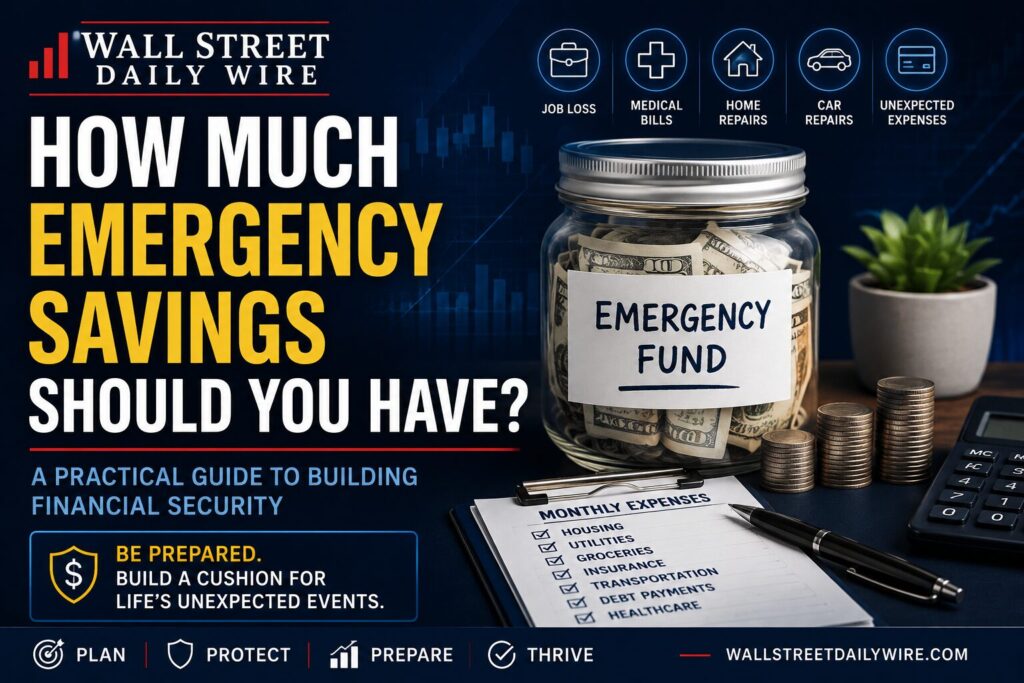
An unexpected car repair. A medical bill. A broken furnace. A sudden job loss.
Financial emergencies rarely arrive when they’re convenient.
That’s the purpose of an emergency fund: money specifically set aside to absorb unexpected expenses without immediately relying on credit cards, loans or investments intended for longer-term goals.
The traditional recommendation is familiar: keep three to six months of expenses in emergency savings.
That’s a useful starting point. But it isn’t a universal rule.
For some households, three months may provide a reasonable cushion. Others may be more comfortable with six, nine or even twelve months.
The better question isn’t simply How much should I save?
It’s:
How much financial protection does my particular household need?
Start With Essential Monthly Expenses
An emergency fund generally doesn’t need to replace every dollar you normally spend.
Instead, calculate the expenses you’d still need to cover during a serious financial disruption.
Those might include:
- Housing
- Utilities
- Groceries
- Insurance
- Transportation
- Minimum debt payments
- Prescription and healthcare costs
- Childcare
- Other essential household obligations
Suppose those necessities total $3,000 per month.
A three-month emergency fund would be approximately $9,000.
Six months would be approximately $18,000.
Nine months would be approximately $27,000.
That gives you a much more useful target than simply basing the fund on your salary.
Is Three Months Enough?
For some households, it may be.
Someone might reasonably lean toward the lower end of the range if they have relatively stable employment, multiple household incomes, manageable fixed expenses and good insurance coverage.
The important concept is financial resilience.
Consider a household with two working adults whose incomes comfortably cover their expenses. Losing one paycheck would hurt, but the second income could continue supporting part of the household.
Compare that with a household dependent entirely on one person’s income.
The dollar amount of their expenses might be identical, but their financial risks aren’t.
When Six Months or More May Make Sense
A larger emergency fund may be worth considering when your financial situation contains greater uncertainty.
That can include situations such as:
- Your household depends on one income.
- Your income fluctuates substantially.
- You’re self-employed.
- You work in an industry vulnerable to layoffs.
- You have significant family responsibilities.
- You own a home with potentially expensive repairs.
- You have recurring medical expenses.
- Replacing your current job could take considerable time.
- You’re approaching retirement and want a larger cash cushion.
There is a tradeoff.
The larger the emergency fund becomes, the more money you potentially keep in relatively conservative accounts rather than investing for longer-term growth.
That’s why the objective shouldn’t necessarily be accumulating the largest possible cash balance.
It’s finding a level that provides sufficient protection without unnecessarily interfering with your other financial goals.
Where Should Emergency Savings Be Kept?
Emergency money generally has a different job than investment money.
You’re not primarily trying to maximize its return.
You’re trying to make sure it’s safe and accessible when something goes wrong.
Common options include an FDIC-insured savings account, high-yield savings account or money-market deposit account at an insured bank. Federally insured credit unions provide similar protection through the NCUA.
The three characteristics to prioritize are:
Safety. Liquidity. Accessibility.
That doesn’t necessarily mean keeping thousands of dollars in a checking account earning little or no interest.
A competitive savings account can allow emergency money to earn interest while remaining relatively easy to access.
What About CDs?
Certificates of deposit can offer attractive yields, but they introduce another consideration: accessibility.
A traditional CD may impose an early-withdrawal penalty if you need the money before maturity.
That doesn’t automatically make CDs inappropriate, particularly for larger emergency funds. Some savers use a CD ladder, spreading money across CDs with different maturity dates.
But at least part of an emergency fund should generally be available without unnecessary delays or penalties.
When the transmission fails on Tuesday, money becoming available six months from Thursday isn’t particularly helpful.
Should Emergency Money Be Invested in Stocks?
Usually, the purpose of an emergency fund argues against exposing the core reserve to significant stock-market risk.
Imagine investing your entire emergency fund in stocks.
Then two events happen simultaneously:
The economy enters a recession and the stock market falls sharply.
You lose your job.
Now you’re forced to sell investments precisely when their value has declined.
Emergency savings are intended partly to prevent that situation.
Investment accounts and emergency funds therefore serve fundamentally different purposes.
Investments are designed primarily to build wealth.
Emergency savings are designed primarily to protect it.
What If You Have Credit-Card Debt?
This is where personal finance becomes less tidy than simple rules suggest.
Should someone with high-interest credit-card debt build a six-month emergency fund while continuing to pay substantial interest?
Not necessarily.
One possible approach is to first establish a smaller starter emergency fund, then direct additional money toward expensive debt while gradually strengthening savings.
For example:
Stage 1: Build an initial cash cushion.
Stage 2: Aggressively address high-interest debt.
Stage 3: Expand the emergency fund toward the longer-term target.
The appropriate order depends on interest rates, income stability, available credit and individual circumstances.
But having some emergency savings can be important even while eliminating debt.
Otherwise, the next unexpected expense may simply go back onto the credit card you’re trying to pay off.
How to Build an Emergency Fund
An $18,000 savings target can sound intimidating if you’re starting with $500.
Don’t treat it as an all-or-nothing objective.
Build it incrementally.
If you save $100 per week, that’s approximately $5,200 over 52 weeks, excluding interest.
At $200 per week, that’s approximately $10,400.
Automatic transfers can make the process easier.
Schedule money to move from checking into savings shortly after each paycheck arrives. That turns emergency savings into something resembling a recurring household expense rather than whatever happens to remain at the end of the month.
Windfalls can accelerate the process as well.
Tax refunds, bonuses, gifts and other unexpected income can provide opportunities to strengthen the fund without dramatically changing the regular household budget.
When Should You Actually Use It?
Not every unplanned purchase is an emergency.
Before withdrawing money, ask three questions:
Is it necessary?
Is it unexpected?
Does it require reasonably immediate action?
A failed water heater probably qualifies.
A vacation that costs more than expected probably doesn’t.
This distinction is why separate savings accounts for vacations, holiday spending, vehicle replacement and other predictable expenses can be useful.
A roof eventually needs replacement.
Cars eventually need repairs.
Insurance premiums eventually come due.
Those expenses may be unpleasant, but many are foreseeable.
Emergency funds work best when they’re reserved for genuine financial disruptions rather than irregular-but-predictable spending.
Revisit the Number
Your emergency-fund target shouldn’t necessarily remain unchanged forever.
Recalculate it when major life circumstances change.
A new home, marriage, divorce, child, job change, retirement or significant increase in monthly expenses could alter the appropriate amount.
Inflation matters too.
If the household once required $3,000 per month to cover essentials and now requires $3,800, a $9,000 emergency fund no longer represents three months of expenses.
Periodically ask:
If my income disappeared tomorrow, how long could my essential expenses continue without borrowing money or selling long-term investments?
That’s ultimately what the emergency fund is designed to answer.