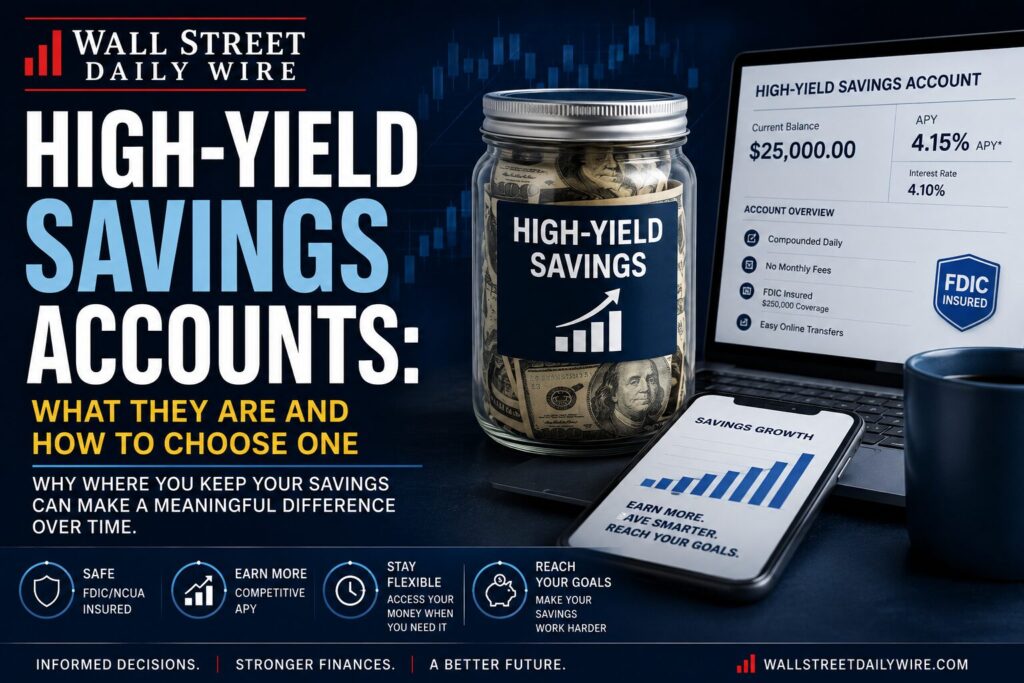
Why where you keep your savings can make a meaningful difference over time
Saving money is important.
But where you keep that money matters too.
Millions of Americans use traditional savings accounts because they’re convenient, familiar and connected to the bank where they already have a checking account.
The problem is that convenience can come with an opportunity cost.
While some traditional savings accounts pay relatively little interest, competitive high-yield savings accounts in July 2026 are offering rates around 4% APY, with some offers reaching roughly 4.15% APY.
That difference can become meaningful as your savings grow.
A high-yield savings account can therefore be one of the simplest tools available for making idle cash work harder — without necessarily sacrificing the accessibility people expect from savings.
What Is a High-Yield Savings Account?
A high-yield savings account, often abbreviated HYSA, is fundamentally still a savings account.
The major difference is the interest rate.
High-yield accounts generally offer substantially higher annual percentage yields than many conventional savings accounts. They’re particularly common among online banks, which may be able to offer competitive rates because they operate without extensive physical branch networks.
Your money isn’t being invested in the stock market.
There aren’t stocks or bonds inside the account.
Instead, you deposit cash with a financial institution and receive interest according to the account’s terms.
That makes high-yield savings potentially useful for money that needs to remain relatively liquid.
Understanding APY
When comparing savings accounts, one of the most important numbers is the annual percentage yield, or APY.
APY represents the amount an account can earn over one year, including the effect of compounding, assuming the rate remains unchanged.
Consider a simplified example.
Suppose you deposit:
$10,000
If an account earns approximately 0.50% APY, $10,000 would generate roughly $50 over one year.
At 4.00% APY, the same $10,000 would generate roughly $400 over one year.
That’s approximately a:
$350 difference.
And you didn’t have to save another dollar to create it.
You simply changed where the existing savings were held.
Actual results depend on the account’s APY, whether the rate changes during the year, the timing of deposits and withdrawals, and other account terms.
High-Yield Doesn’t Mean High Risk
The word yield sometimes makes financial products sound more complicated than they are.
A high-yield savings account at an FDIC-insured bank is still a bank deposit.
FDIC deposit insurance currently provides coverage of $250,000 per depositor, per FDIC-insured bank, for each account ownership category.
Federally insured credit unions receive similar protection through the National Credit Union Share Insurance Fund administered by the NCUA. Individual accounts at federally insured credit unions are generally insured up to $250,000, subject to applicable ownership rules.
That’s why verifying deposit insurance should be part of evaluating any unfamiliar bank or credit union offering an attractive rate.
A flashy APY alone isn’t enough.
Why Online Banks Often Pay More
Traditional banks operate branches, ATMs and extensive physical infrastructure.
Online banks can have a different cost structure.
Some pass part of those savings to depositors through higher interest rates.
That doesn’t automatically make an online bank better.
It simply changes the tradeoff.
A traditional bank might provide:
Branches + face-to-face service + convenience
while an online savings account might emphasize:
Higher APY + digital banking + lower overhead
Some consumers use both.
They maintain checking at their primary bank while keeping emergency savings at a different institution offering a more competitive yield.
What Should You Use a High-Yield Savings Account For?
A HYSA can be particularly useful for money that you want protected from normal spending but may still need relatively quickly.
Examples include:
Emergency savings
Your emergency fund is one of the most obvious candidates.
Home down payment
Money being accumulated toward a near-term home purchase generally requires different considerations than money intended for retirement decades from now.
Car fund
Saving toward your next vehicle can potentially earn interest while you’re accumulating the purchase price.
Vacation fund
A dedicated account can separate vacation savings from everyday spending.
Large upcoming expenses
Home repairs, insurance premiums, tuition or other predictable expenses can potentially be accumulated separately.
In other words:
High-yield savings can provide a middle ground between everyday checking and long-term investing.
A High-Yield Savings Account Isn’t an Investment Account
This distinction is important.
A savings account serves a different purpose from a brokerage or retirement account.
Investing generally involves accepting some degree of market risk in pursuit of greater long-term returns.
Savings prioritizes:
Principal stability + liquidity + accessibility
That makes comparing a 4% savings APY with the historical return of stocks somewhat misleading.
They’re solving different financial problems.
Money needed next month probably shouldn’t be exposed to the same volatility as money intended for retirement 30 years from now.
Your APY Can Change
This is one of the biggest differences between high-yield savings accounts and certificates of deposit.
Savings rates are generally variable.
A bank offering 4.00% today isn’t necessarily promising 4.00% indefinitely.
Rates can rise or fall depending on economic conditions, competition for deposits and Federal Reserve monetary policy.
CDs work differently.
They generally allow savers to lock in a specified rate for a predetermined term, but withdrawing the money early can result in penalties.
Savings accounts usually provide greater flexibility.
CDs generally provide greater rate certainty.
Neither is automatically better.
The right choice depends on what the money is intended to accomplish.
Don’t Choose an Account Based on APY Alone
Suppose Bank A offers 4.00%.
Bank B offers 4.15%.
Bank B automatically looks better.
But not necessarily.
Before moving your money, investigate the entire account.
1. Monthly fees
A high interest rate doesn’t accomplish much if account fees consume your earnings.
Look for accounts with no monthly maintenance fee or requirements you’re comfortable meeting.
2. Minimum balance requirements
Some advertised yields apply only after maintaining certain balances.
Others may impose minimum opening deposits.
Understand the requirements before opening the account.
3. How easy is your money to access?
Consider how you’ll move money between savings and checking.
Transfers between separate financial institutions aren’t always instantaneous.
That matters if the account contains your emergency fund.
4. Deposit insurance
Verify that the bank is FDIC insured or that the credit union has appropriate NCUA coverage.
Don’t simply assume an unfamiliar financial app is itself a bank.
Some financial-technology companies place customer funds at partner banks, which can make understanding exactly where deposits are held particularly important.
5. APY requirements
Read the fine print.
An advertised rate might apply only to certain balances, customers or account conditions.
6. Customer service
A slightly higher APY may not compensate for poor service when you urgently need access to your money.
What About Withdrawal Limits?
There’s still confusion surrounding the old rule limiting certain savings-account transactions to six per month.
The Federal Reserve removed the Regulation D six-per-month limit on convenient savings transfers in 2020.
However, that doesn’t necessarily mean every savings account allows unlimited transactions without restrictions.
Financial institutions may maintain their own account policies or fees. The Federal Reserve specifically notes that Regulation D doesn’t prohibit institutions from maintaining certain policies concerning savings withdrawals.
Check the terms of the particular account you’re considering.
The Difference Gets Bigger as Your Savings Grow
Consider what happens as account balances increase.
Using simplified annual figures at 0.50% versus 4.00%:
| Savings | 0.50% APY | 4.00% APY | Approx. Difference |
| $1,000 | $5 | $40 | $35 |
| $5,000 | $25 | $200 | $175 |
| $10,000 | $50 | $400 | $350 |
| $25,000 | $125 | $1,000 | $875 |
| $50,000 | $250 | $2,000 | $1,750 |
These figures are simplified illustrations rather than guaranteed returns and assume the stated APY remains unchanged.
The lesson isn’t that everyone needs to chase the highest rate available.
It’s that rate differences become increasingly consequential as cash balances grow.
Don’t Chase Every Rate Change
There is another extreme worth avoiding.
Suppose your savings account pays 4.00%, while another bank increases its rate to 4.10%.
Moving all your money every time another institution offers another tenth of a percentage point can become unnecessary financial busywork.
On $10,000, the difference between 4.00% and 4.10% is only about $10 over a year, assuming rates remain unchanged.
That’s very different from leaving $10,000 earning 0.10% when readily available alternatives offer something around 4%.
Focus on meaningful differences, not constant optimization.