The Microsoft Story Has Entered a New Phase
For much of the generative-AI boom, Microsoft’s investment case appeared straightforward.
The company had an early strategic relationship with OpenAI, enormous enterprise distribution, Azure infrastructure and a portfolio ranging from Microsoft 365 to GitHub.
The opportunity was obvious.
Now the expectations are considerably higher.
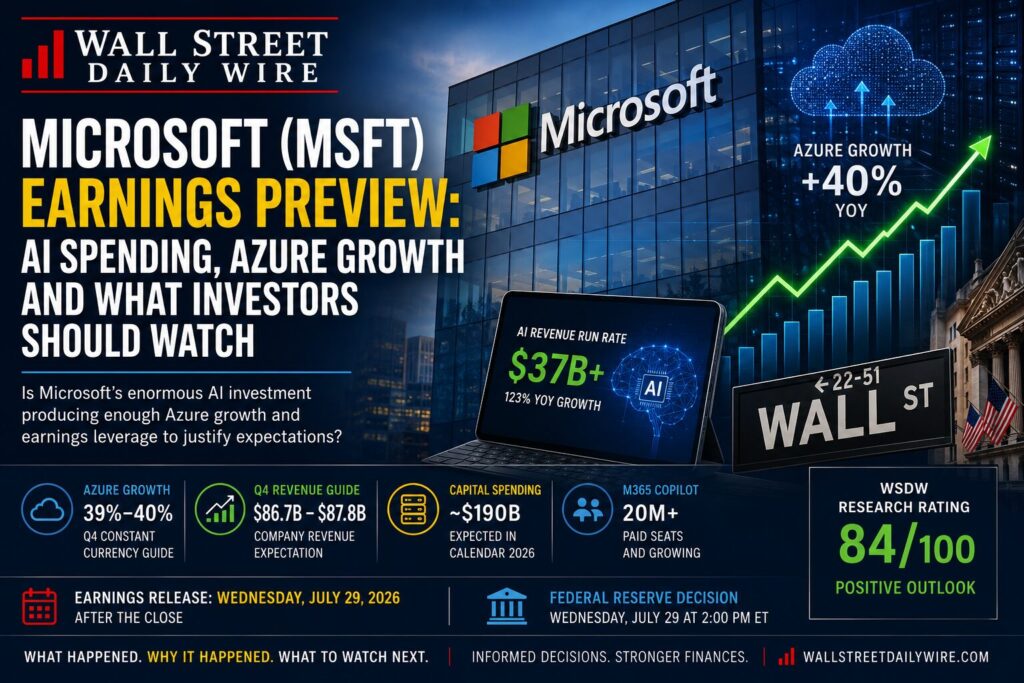
Microsoft’s AI business surpassed a $37 billion annual revenue run rate during Q3, growing 123% year over year. Microsoft 365 Copilot paid seats surpassed 20 million. Meanwhile, demand for Azure services continues to exceed Microsoft’s available capacity.
Those are impressive numbers.
But investors are increasingly asking a different question:
How much does Microsoft have to spend to generate that growth?
That may ultimately determine how Wall Street interprets Microsoft’s July 29 report.
Azure Remains the Centerpiece
Microsoft’s fiscal third quarter provided substantial evidence that cloud demand remains strong.
Azure and other cloud-services revenue increased 40% year over year, or 39% in constant currency. Intelligent Cloud revenue increased 30% to approximately $34.7 billion.
Management indicated that demand continued to exceed available capacity.
That makes Microsoft’s Q4 guidance especially significant.
The company expects Azure growth of approximately 39%–40% in constant currency, despite comparison against a strong prior-year quarter. Management has also said Azure growth could modestly accelerate during the second half of calendar 2026 as additional capacity comes online.
If Microsoft delivers within or above that range, it would strengthen the argument that AI infrastructure investment is translating into sustained cloud growth.
A meaningful miss would raise considerably more difficult questions.
The $190 Billion Question
Microsoft’s AI opportunity comes with an extraordinary price tag.
Management expects capital expenditures to exceed $40 billion in fiscal Q4 alone and reach roughly $190 billion during calendar 2026. Approximately $25 billion of that annual spending reflects higher component prices.
That spending is helping Microsoft expand GPU, CPU, storage and data-center capacity.
But it is also pressuring margins.
Microsoft Cloud gross margin declined to 66% in Q3, compared with 69% in the year-earlier period, with Microsoft attributing part of the decline to continued AI infrastructure investment and increased AI-product usage. Management expects cloud gross margin of approximately 64% in Q4.
This creates one of the most important tensions in the Microsoft investment thesis:
Demand is exceptionally strong, but supplying that demand is exceptionally expensive.
Copilot Is Becoming More Important
Infrastructure is only part of Microsoft’s AI strategy.
The larger opportunity may eventually come from selling AI applications throughout Microsoft’s existing ecosystem.
Microsoft 365 Copilot is particularly important.
Paid M365 Copilot seats exceeded 20 million during Q3, up from approximately 15 million previously disclosed in January. Management expects net paid-seat additions to increase sequentially in Q4.
That makes Copilot adoption an important indicator to watch.
Azure demonstrates Microsoft’s ability to monetize AI infrastructure.
Copilot could demonstrate Microsoft’s ability to monetize AI throughout its enormous installed software base.
The combination would make Microsoft’s AI economics considerably more compelling.
The Broader Business Remains Powerful
Microsoft’s investment case extends well beyond Azure.
Q3 Microsoft Cloud revenue reached $54.5 billion, increasing 29%. Productivity and Business Processes revenue reached approximately $35 billion, increasing 17%. Microsoft 365 Commercial cloud revenue increased 19%, LinkedIn increased 12%, and Dynamics 365 increased 22%.
There are weaker areas.
More Personal Computing revenue declined 1% in Q3, while Xbox content and services revenue fell 5%. Management also expects Windows OEM revenue to decline sharply in Q4 amid difficult comparisons, inventory normalization and PC-market pressures.
But Microsoft increasingly derives its investment strength from cloud, enterprise software and AI rather than traditional PC economics.