S&P 500 +0.00% Nasdaq +0.00% Dow -0.00% Russell 2000 0.00% VIX 0.00 10Y 0.00% BTC $0 Gold $0 Oil $0

Microsoft (MSFT) Earnings Preview: AI Spending, Azure Growth and What Investors Should Watch

Azure growth remains strong and AI demand continues to outpace capacity—but Microsoft’s enormous infrastructure spending raises the stakes for its fiscal fourth-quarter results.

MSFT

Key Takeaways

  • * Microsoft reports fiscal Q4 results Wednesday, July 29.
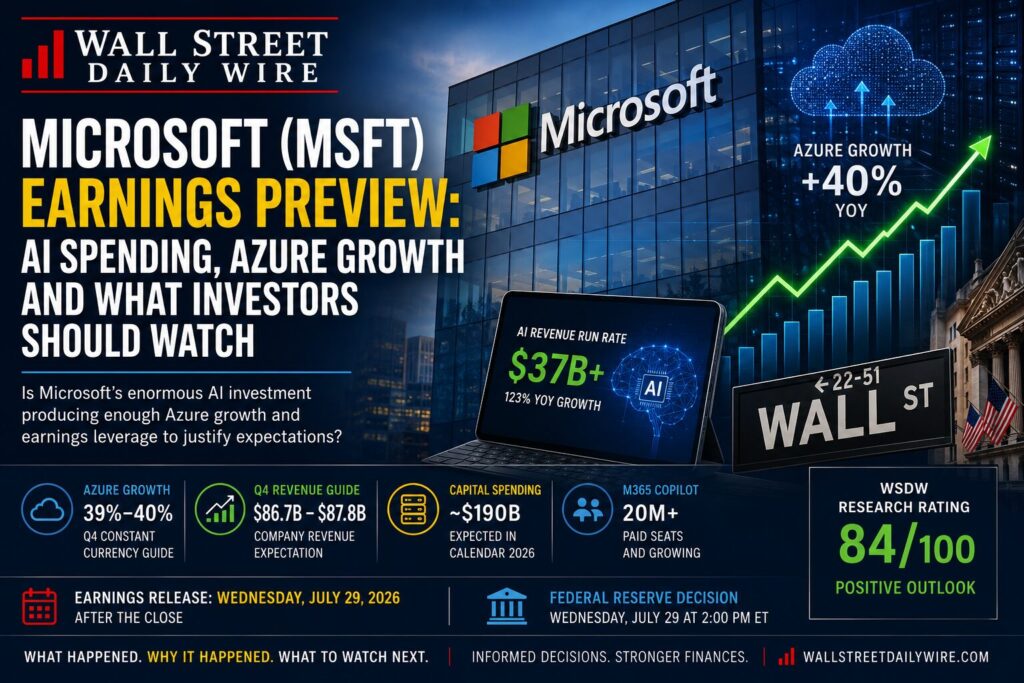
  • * Q3 revenue increased 18% to $82.9 billion, while diluted EPS reached $4.27.
  • * Azure and other cloud-services revenue grew 40% in Q3.
  • * Management guided Q4 Azure growth to 39%–40% in constant currency.
  • * Microsoft expects Q4 company revenue of approximately $86.7 billion to $87.8 billion.
  • * Microsoft expects more than $40 billion of Q4 capital expenditures and roughly $190 billion during calendar 2026.
  • * The central question is no longer whether Microsoft has AI demand. It is whether the economics of supplying that demand can justify the extraordinary investment required.
WSDW Rating

Research Snapshot

84/100
OutlookPositive
RiskAbove Average
ValuationElevated
MomentumPositive
Financial QualityStrong

Editorial research assessment only. Not individualized investment advice. Read the rating methodology.

The Microsoft Story Has Entered a New Phase

For much of the generative-AI boom, Microsoft’s investment case appeared straightforward.

The company had an early strategic relationship with OpenAI, enormous enterprise distribution, Azure infrastructure and a portfolio ranging from Microsoft 365 to GitHub.

The opportunity was obvious.

Now the expectations are considerably higher.

Microsoft’s AI business surpassed a $37 billion annual revenue run rate during Q3, growing 123% year over year. Microsoft 365 Copilot paid seats surpassed 20 million. Meanwhile, demand for Azure services continues to exceed Microsoft’s available capacity. 

Those are impressive numbers.

But investors are increasingly asking a different question:

How much does Microsoft have to spend to generate that growth?

That may ultimately determine how Wall Street interprets Microsoft’s July 29 report.

Azure Remains the Centerpiece

Microsoft’s fiscal third quarter provided substantial evidence that cloud demand remains strong.

Azure and other cloud-services revenue increased 40% year over year, or 39% in constant currency. Intelligent Cloud revenue increased 30% to approximately $34.7 billion

Management indicated that demand continued to exceed available capacity.

That makes Microsoft’s Q4 guidance especially significant.

The company expects Azure growth of approximately 39%–40% in constant currency, despite comparison against a strong prior-year quarter. Management has also said Azure growth could modestly accelerate during the second half of calendar 2026 as additional capacity comes online. 

If Microsoft delivers within or above that range, it would strengthen the argument that AI infrastructure investment is translating into sustained cloud growth.

A meaningful miss would raise considerably more difficult questions.

The $190 Billion Question

Microsoft’s AI opportunity comes with an extraordinary price tag.

Management expects capital expenditures to exceed $40 billion in fiscal Q4 alone and reach roughly $190 billion during calendar 2026. Approximately $25 billion of that annual spending reflects higher component prices. 

That spending is helping Microsoft expand GPU, CPU, storage and data-center capacity.

But it is also pressuring margins.

Microsoft Cloud gross margin declined to 66% in Q3, compared with 69% in the year-earlier period, with Microsoft attributing part of the decline to continued AI infrastructure investment and increased AI-product usage. Management expects cloud gross margin of approximately 64% in Q4

This creates one of the most important tensions in the Microsoft investment thesis:

Demand is exceptionally strong, but supplying that demand is exceptionally expensive.

Copilot Is Becoming More Important

Infrastructure is only part of Microsoft’s AI strategy.

The larger opportunity may eventually come from selling AI applications throughout Microsoft’s existing ecosystem.

Microsoft 365 Copilot is particularly important.

Paid M365 Copilot seats exceeded 20 million during Q3, up from approximately 15 million previously disclosed in January. Management expects net paid-seat additions to increase sequentially in Q4. 

That makes Copilot adoption an important indicator to watch.

Azure demonstrates Microsoft’s ability to monetize AI infrastructure.

Copilot could demonstrate Microsoft’s ability to monetize AI throughout its enormous installed software base.

The combination would make Microsoft’s AI economics considerably more compelling.

The Broader Business Remains Powerful

Microsoft’s investment case extends well beyond Azure.

Q3 Microsoft Cloud revenue reached $54.5 billion, increasing 29%. Productivity and Business Processes revenue reached approximately $35 billion, increasing 17%. Microsoft 365 Commercial cloud revenue increased 19%, LinkedIn increased 12%, and Dynamics 365 increased 22%. 

There are weaker areas.

More Personal Computing revenue declined 1% in Q3, while Xbox content and services revenue fell 5%. Management also expects Windows OEM revenue to decline sharply in Q4 amid difficult comparisons, inventory normalization and PC-market pressures. 

But Microsoft increasingly derives its investment strength from cloud, enterprise software and AI rather than traditional PC economics.


Why It Matters

Microsoft is becoming one of the clearest tests of the financial economics behind the AI infrastructure boom.

The company isn’t struggling to find demand.

Its problem is almost the opposite: Microsoft says customer demand continues to exceed available cloud capacity.

The question is whether hundreds of billions of dollars of infrastructure investment ultimately produces sufficiently attractive margins and cash flows.

If it does, Microsoft’s current spending cycle may eventually look like construction of one of the world’s most valuable technology infrastructures.

If returns disappoint, investors could become far less tolerant of enormous AI capital budgets.

What to Watch

What to Watch on July 29

1. Azure growth

The benchmark is management’s 39%–40% constant-currency growth guidance. A result above that range would provide another strong demand signal.

2. Fiscal 2027 Azure guidance

This may matter even more than the reported Q4 number. Investors will want to know whether management sees AI demand sustaining Azure’s current growth trajectory.

3. Capital expenditures

Microsoft expects Q4 CapEx above $40 billion. Watch both the actual number and management’s commentary regarding future infrastructure requirements.

4. Microsoft Cloud margins

Growth accompanied by continued margin compression will receive more scrutiny than growth accompanied by improving infrastructure efficiency.

5. Copilot adoption

Microsoft reported more than 20 million paid M365 Copilot seats in Q3. Continued acceleration would strengthen the software-monetization side of the AI thesis.

6. Capacity constraints

Management previously expected Microsoft to remain capacity constrained through at least 2026. Any change to that timetable could influence expectations for Azure growth and capital expenditures.

Bull Case

The case for upside

The case for upside

Microsoft may possess one of the strongest combinations of AI infrastructure, software distribution and enterprise relationships in the technology industry.

Azure continues growing around 40%.

AI revenue has surpassed a $37 billion annual run rate.

Microsoft 365 Copilot has surpassed 20 million paid seats.

And Microsoft’s commercial remaining performance obligation reached approximately $627 billion in Q3, reflecting a substantial amount of contracted future business.

If Microsoft can maintain strong Azure growth while expanding Copilot adoption and eventually improving infrastructure efficiency, today’s capital spending could support another major leg of long-term earnings growth.

Bear Case

The risks to watch

The risks to watch

The biggest risk may be that Microsoft’s AI opportunity proves enormously valuable—but less profitable than investors expect.

Microsoft Cloud gross margin has already declined as infrastructure investment and AI usage increase.

Competition is also intense.

Alphabet, Amazon and other technology companies continue investing aggressively in cloud infrastructure and AI. Microsoft can therefore spend enormous sums without guaranteeing that all incremental demand produces superior returns.

There is also execution risk around Copilot.

Twenty million paid seats represents substantial progress, but remains relatively small compared with Microsoft’s enormous commercial user base. Investors will eventually expect AI applications to become financially material enough to help justify the infrastructure supporting them.

The WSDW Take

Microsoft enters fiscal fourth-quarter earnings with a fundamentally strong business.

Azure is growing rapidly.

Cloud demand remains greater than available capacity.

The company’s AI business is already producing tens of billions of dollars in annualized revenue.

And Microsoft possesses one of the broadest enterprise distribution networks in technology.

The concern is not the absence of growth.

It is the cost of achieving that growth.

That distinction matters.

Microsoft’s July 29 report therefore isn’t simply another quarterly earnings announcement. It is another test of whether one of the world’s largest AI capital-spending programs is producing returns quickly enough to justify its scale.

Pre-Earnings WSDW Rating: 84/100 — Positive

Outlook: Positive
Risk: Above Average
Valuation: Elevated
Momentum: Positive
Financial Quality: Strong

The strongest result would combine Azure growth at or above guidance with accelerating Copilot adoption and evidence that infrastructure efficiency can eventually stabilize cloud margins.

The most concerning result would be slowing Azure growth combined with still-rising capital requirements.

That is the equation investors should watch Wednesday.

Disclosure

Wall Street Daily Wire provides financial news, research and analysis for informational and educational purposes. WSDW ratings represent editorial research assessments and are not individualized investment advice or recommendations to buy or sell securities. Investing involves risk, including possible loss of principal. The author does not hold a position in MSFT at the time of the publication of this article.

General Disclosure

Wall Street Daily Wire provides financial news, commentary and educational information. Nothing on this page is individualized investment, tax or legal advice. Investing involves risk, including possible loss of principal.

About the Author

Wall Street Daily Wire Staff

More from this author →
Wall Street Daily Wire Morning Brief

Start the day knowing what matters.

Markets, stocks, economic developments and key catalysts — distilled into one quick morning read.