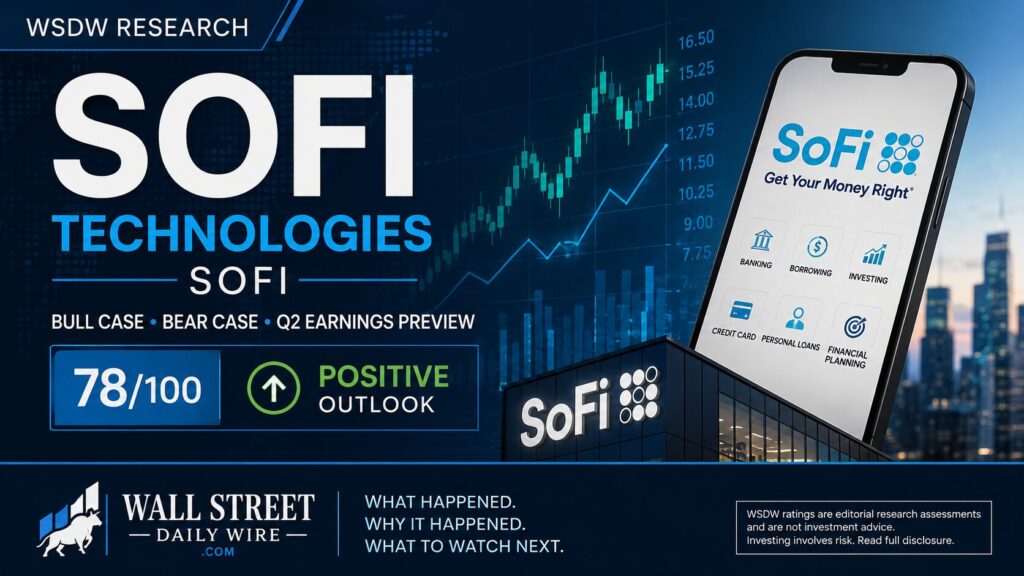
SoFi Technologies (SOFI): Bull Case, Bear Case and What to Watch Ahead of Q2 Earnings.
SoFi enters its second-quarter report with strong revenue growth, expanding profitability and rapid member growth—but its valuation and expectations leave investors with plenty to watch.
* SoFi produced record Q1 adjusted net revenue of approximately $1.1 billion, up 41% year over year.
* GAAP net income reached $166.7 million, marking its tenth consecutive profitable quarter.
* Membership increased 35% year over year to 14.7 million.
* Management entered Q2 expecting approximately 30% adjusted-net-revenue growth.
* Q2 earnings on July 29 represent the next major test for the growth story.
* The primary question for investors is increasingly not whether SoFi can grow, but whether growth and profitability can justify the stock’s valuation.
SoFi reported Q1 adjusted EBITDA of $339.9 million, up 62% year over year, while total loan originations reached a record $12.2 billion.
For years, the central investment question surrounding SoFi Technologies was relatively straightforward: could the rapidly growing financial-technology company translate member and product growth into sustainable profitability?
That question is becoming less relevant.
SoFi reported its tenth consecutive quarter of GAAP profitability in the first quarter of 2026, generating $166.7 million of net income and diluted earnings per share of $0.12. Adjusted EBITDA climbed 62% year over year to approximately $340 million.
The more important question now is whether SoFi can maintain its growth trajectory while expanding profitability enough to support investors’ expectations.
That makes the company’s July 29 second-quarter earnings report particularly important.
Growth Remains the Centerpiece
SoFi’s first-quarter numbers established a high bar.
GAAP net revenue reached approximately $1.1 billion, increasing 43% from the prior-year quarter, while adjusted net revenue grew 41%. Members increased 35% to 14.7 million and products grew 39% to 22.2 million.
Lending also remained powerful.
Total loan originations reached a record $12.2 billion, while Lending segment adjusted net revenue increased 53% year over year. Financial Services segment revenue increased 41%.
Those figures strengthen the argument that SoFi is developing into something broader than the student-loan refinancing business with which many investors still associate the company.
Diversification Matters
One of the most important pieces of the SoFi investment thesis is diversification.
Financial Services and Technology Platform collectively generated $503.6 million of Q1 net revenue, increasing 24% from the previous year. Fee-based revenue reached $386.8 million.
SoFi has also continued broadening its product ecosystem. Recent initiatives include small-business lending, additional ETFs, an AI-powered financial guide called SoFi Coach, and SoFiUSD, which the company describes as a stablecoin issued by a U.S. national bank.
The strategic objective is increasingly apparent: attract customers through one financial product and build a relationship spanning banking, borrowing, investing and other financial services.
Execution remains the critical issue.
Why It Matters
SoFi is reaching the stage where investors may increasingly evaluate it as a profitable financial institution and financial-services platform rather than simply a high-growth fintech company.
That transition could ultimately support a stronger investment case—but it also raises expectations.
Revenue growth alone becomes less important as investors begin scrutinizing margins, earnings per share, credit quality and returns generated from that growth.
What to Watch
What to Watch on July 29
I’d make these the five numbers/issues WSDW readers watch:
1. Revenue growth — management previously guided toward approximately 30% adjusted-net-revenue growth for Q2.
2. Adjusted EBITDA margin — previous Q2 guidance was approximately 30%.
3. Member growth — whether the exceptionally strong acquisition trajectory continues.
4. Credit performance — particularly personal-loan delinquencies and charge-offs.
5. Full-year guidance — perhaps the most consequential piece of the report.
Those Q2 and full-year benchmarks come directly from SoFi’s Q1 guidance.
Bull Case
The case for upside
The strongest argument for SoFi is the combination of growth and improving profitability.
Management’s full-year 2026 outlook following Q1 called for approximately $4.655 billion in adjusted net revenue, roughly $1.6 billion in adjusted EBITDA, approximately $825 million in adjusted net income and adjusted EPS of about $0.60. Management also expected membership growth of at least 30%.
If SoFi continues producing approximately 30% revenue growth while expanding margins and generating sustainable GAAP profits, the company could increasingly justify being valued as a premium financial-services growth business.
Its expanding ecosystem also creates opportunities to deepen relationships with existing members rather than relying entirely on acquiring new customers.
Bear Case
The risks to watch
Expectations are becoming more demanding.
SOFI closed at $16.46 on July 24, and available market data put its trailing P/E at roughly 36.6.
That means continued operating improvement matters.
Lending remains an important contributor to SoFi’s economics, leaving the business exposed to credit conditions and changes in consumer financial health.
The Technology Platform also deserves scrutiny. Enabled accounts were approximately 132.9 million at the end of Q1, down 16% year over year, partly reflecting the departure of a large client that completed its transition off the platform.
A growth stock priced for continued execution can react sharply when results merely meet expectations rather than substantially exceed them.
The WSDW Take
SoFi’s fundamental story looks considerably stronger than it did several years ago.
The company is growing rapidly, has established sustained GAAP profitability, continues expanding its member base and is developing revenue streams beyond traditional lending.
That earns SOFI a Positive WSDW outlook.
But positive does not mean risk-free.
At approximately $16.46 heading into the final week before earnings, investors are buying a company from which the market already expects substantial growth.
For that reason, Wall Street Daily Wire currently views SOFI as an attractive growth company accompanied by above-average investment risk.
WSDW Rating: 78/100 — Positive
The July 29 report should tell investors whether SoFi’s operating performance continues moving quickly enough to support that assessment.
Disclosure
Wall Street Daily Wire provides financial news, research and analysis for informational and educational purposes. WSDW ratings represent editorial research assessments and are not individualized investment advice or recommendations to buy or sell securities. Investing involves risk, including possible loss of principal. The author does not hold a position in SOFI as of the publication date of this article.
General Disclosure
Wall Street Daily Wire provides financial news, commentary and educational information. Nothing on this page is individualized investment, tax or legal advice. Investing involves risk, including possible loss of principal.